












Amnesty International’s Global Report: Death Sentences and Executions 2024 shows a significant rise in executions worldwide, even as the number of countries applying capital punishment continues to decline. According to the organisation, 15 countries carried out at least 1,518 executions in 2024 — the highest recorded total since 2015.
The report notes that limited transparency in countries such as China, North Korea, and Vietnam means the true global numbers are likely much higher.
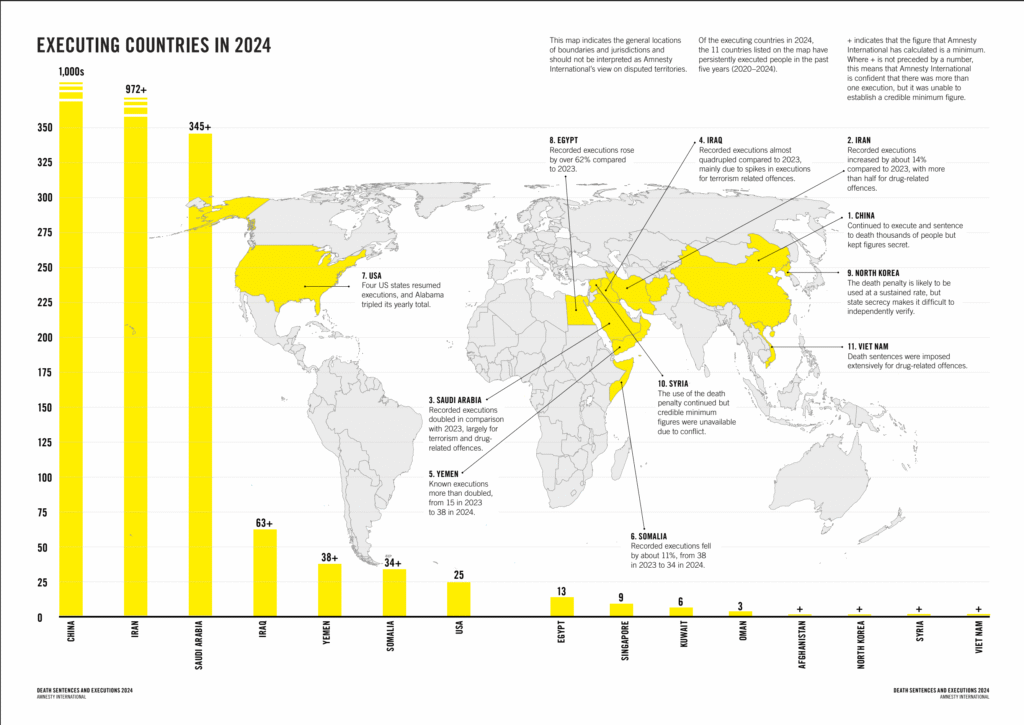
Middle East Drives Majority of Recorded Executions
The increase was primarily driven by three countries:
- Iran: at least 972 executions (64% of the global total)
- Saudi Arabia: at least 345 executions, doubling its 2023 figure
- Iraq: at least 63 executions, a four-fold increase
These three nations together accounted for 91% of all recorded executions. The report also documented notable increases in Egypt, Singapore, and Yemen.
Africa: Varied Legal Approaches Across the Continent
Across Africa, countries differed widely in their application of capital punishment.
Some states issued or carried out executions, while others took steps to change their legal frameworks.
Somalia remained the only Sub-Saharan African country that carried out executions in both 2023 and 2024, recording 34 executions last year. This figure was the region’s second-highest annual total since 2015.
Death sentences increased in several African countries, including:
- Democratic Republic of the Congo (33 to 125)
- Mauritania (5 to 23)
- Sudan (0 to 30)
- Niger (8 to 16)
- Tanzania (3 to 12)
- Uganda (0 to 2)
- Mali (13 to 16)
Meanwhile, Zimbabwe abolished the death penalty for ordinary crimes, and Zambia ratified the UN protocol linked to abolition, following its full repeal in 2023.
Global Death Sentences Decline Slightly
New death sentences fell by 14%, with 46 countries imposing 2,087 sentences in 2024. Eight countries that issued death sentences in 2023 did not do so last year, including Cameroon, Gambia, Guyana, Qatar, Taiwan, and the Maldives.
At the end of 2024, at least 28,085 people remained on death row worldwide, with 42% in the Asia-Pacific region.
Drug-Related Cases Form a Significant Portion of Executions
Amnesty reported that 42% of recorded executions were for drug-related offenses, carried out in at least four countries: Iran, Saudi Arabia, Singapore, and China.
Iran executed 505 people for drug charges, while Saudi Arabia recorded 122 drug-related executions. In total, 13 countries handed down more than 337 new death sentences for drug offenses in 2024.
Security-Related Charges Prominent in Several Countries
The report notes that executions linked to state security, terrorism laws, and public-order charges remained common in Iran, Iraq, and Saudi Arabia. Amnesty highlighted cases where individuals accused of anti-government activities or involvement in protests received death sentences or were executed.
Commutations and Legal Reviews Recorded in Some States
The report also documented:
- Commutations or pardons in 18 countries
- Nine exonerations in Japan, Malaysia, and the United States
- Over 1,000 resentencing decisions in Malaysia after legal reforms
- A decline in U.S. death row numbers, partly due to commutations by President Joe Biden and North Carolina Governor Roy Cooper
A Global System with Diverse Legal Practices
The 2024 report illustrates a world where capital punishment remains deeply varied. Some countries maintain or expand its use for crimes such as murder, drug trafficking, and terrorism, citing national law and security concerns. Others continue to alter or restrict the practice within their legal systems.
While Amnesty International evaluates these actions through its human rights framework, the global application of the death penalty ultimately reflects the differing legal traditions, policies, and sovereign decisions of individual states.