













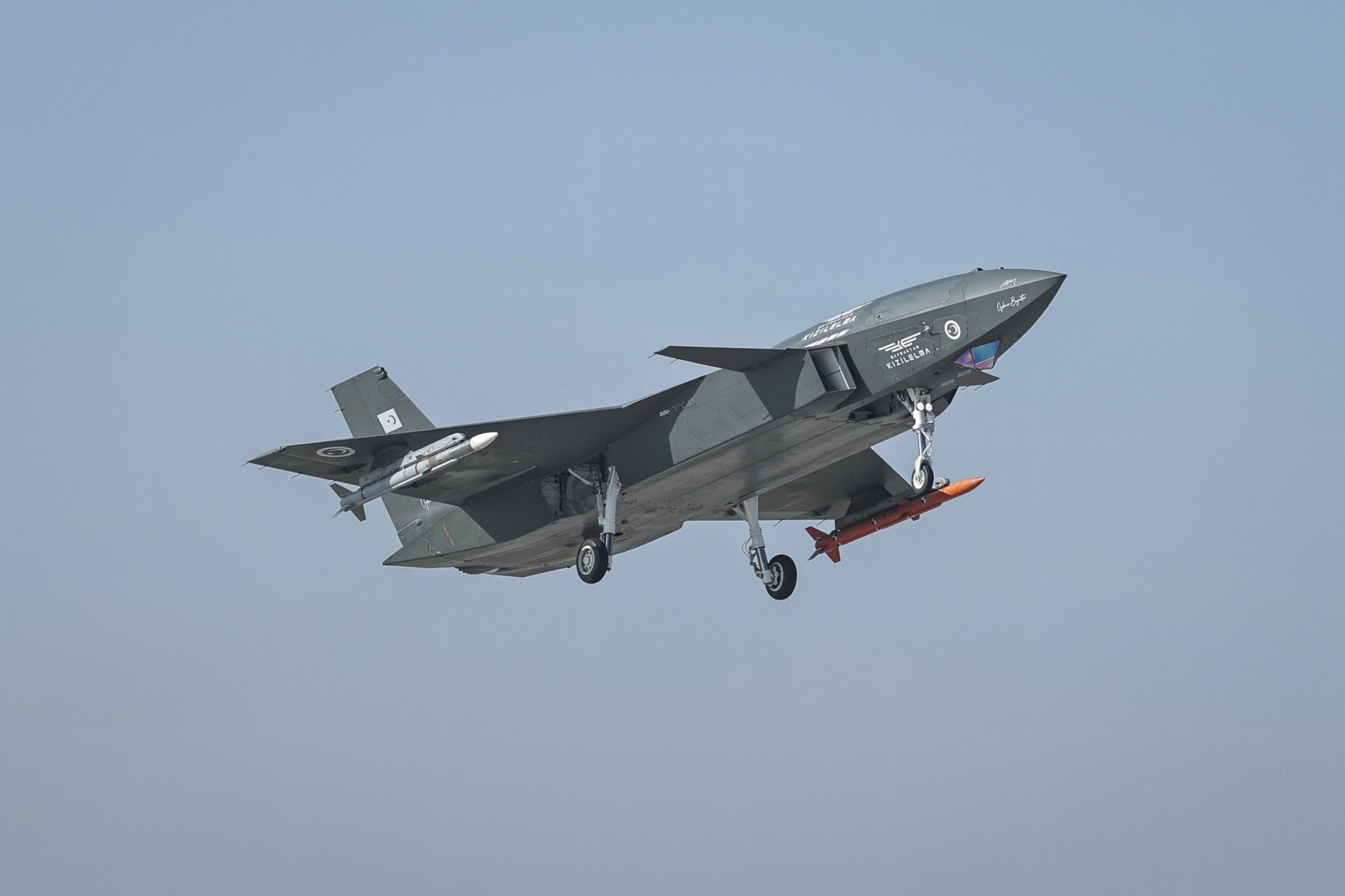
Türkiye has marked a major breakthrough in global aviation after its unmanned fighter jet, Bayraktar Kizilelma, became the first drone to shoot down a jet-powered aerial target using a beyond-visual-range (BVR) air-to-air missile. The milestone was confirmed by defense company Baykar and multiple independent defense observers.
Historic Test Over the Black Sea
The test took place off the coast of Sinop, where Kizilelma detected, tracked, and destroyed a fast-moving target jet. The drone fired the indigenously designed Gökdoğan BVR missile following targeting data from Aselsan’s Murad AESA radar, completing the strike using fully national systems.
Baykar states that this is the first time in global aviation history that an unmanned fighter has executed a full air-to-air kill chain, from radar detection to missile launch, against a jet-powered target. It also marks the first time in Türkiye’s aviation history that a domestically built aircraft, radar, and missile were integrated in a successful engagement.
National Pride After a Major Breakthrough
Baykar CEO Haluk Bayraktar described the achievement as a turning point. He emphasized that the entire engagement—aircraft, radar, and missile—relied solely on domestic technology.
Selçuk Bayraktar, Baykar’s chair and chief technology officer, said Kizilelma’s strike “opened a new era” in unmanned air combat, noting that the UAV had achieved “another first in aviation history.”
Defense officials say the test represents a technological leap that positions Türkiye among the limited number of nations developing unmanned fighters with verified air-to-air combat capability.
Manned–Unmanned Teaming Demonstrated
The test scenario included five F-16 fighter jets from Merzifon Air Base flying alongside Kizilelma to demonstrate future manned–unmanned teaming tactics. A Bayraktar Akıncı UAV recorded the mission from above.
Kizilelma detected the target using Murad AESA radar, maintained the lock, and launched the Gökdoğan missile, which successfully intercepted and destroyed the jet-powered target at long range. Analysts say the profile reflects a complete air-to-air engagement rather than a simple missile test.
Haluk Gorgun, head of Türkiye’s Defense Industries Secretariat, said the strike showcased the maturity of Türkiye’s national defense ecosystem, demonstrating coordinated engineering across sensors, control systems, and missile technology.
Stealthy, Networked and Multi-Role Capabilities
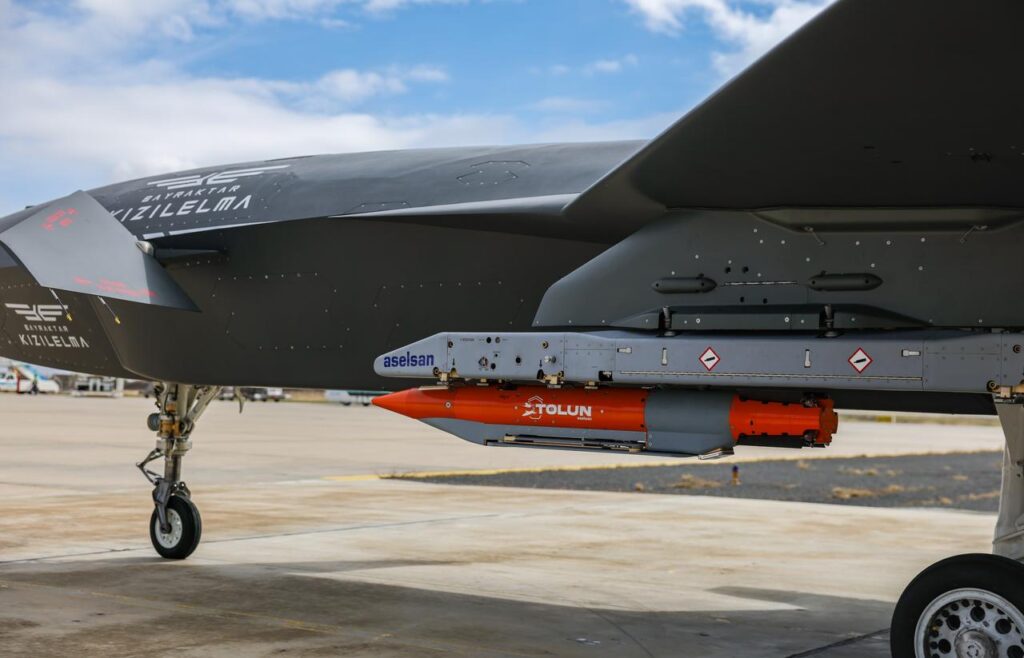
Kizilelma features a low radar cross-section and advanced onboard sensors, allowing it to detect threats at long range while remaining difficult to track. Its systems include:
- Murad AESA radar
- Toygun electro-optical targeting system
- A wide range of Turkish munitions, including Tolun and Teber-82 bombs
The UAV has now verified performance in both air-to-ground and air-to-air roles, evolving from a concept platform into an operationally credible unmanned fighter.
Baykar’s Export Success and Türkiye’s Defense Ecosystem
Baykar has funded its UAV programs independently since 2003 and generated $1.8 billion in export revenues in both 2023 and 2024. Roughly 90% of its income comes from international customers.
The company has reached export agreements with:
- 36 countries for Bayraktar TB2
- 16 countries for Bayraktar Akıncı
Baykar has also been Türkiye’s top defense and aerospace exporter for four years in a row.
Aselsan, responsible for the Murad radar and mission-critical systems, said the test demonstrates the power of fully integrated national solutions. Roketsan, maker of the Gökdoğan missile, noted that the engagement could “reshape the rules of aerial combat.”
Industry and Technology Minister Mehmet Fatih Kacır described the trial as a global milestone, reflecting Türkiye’s rising capabilities in next-generation air warfare.
Why the Test Matters
Kizilelma’s success is historic because it marks the first-ever UAV shootdown of a jet-powered target using a BVR missile. No other drone has publicly demonstrated the ability to complete the entire kill chain autonomously.
Every component involved—the fighter UAV, radar, data link, and missile—was developed domestically, establishing a fully sovereign national air-combat system.
The test also strengthens Türkiye’s position in manned–unmanned teaming, a key focus of modern air forces, as Kizilelma operated alongside F-16s and Akıncı.
This achievement reinforces Türkiye’s growing role in autonomous air-combat technologies and elevates its defense industry at a time when Baykar already leads national aerospace exports.