







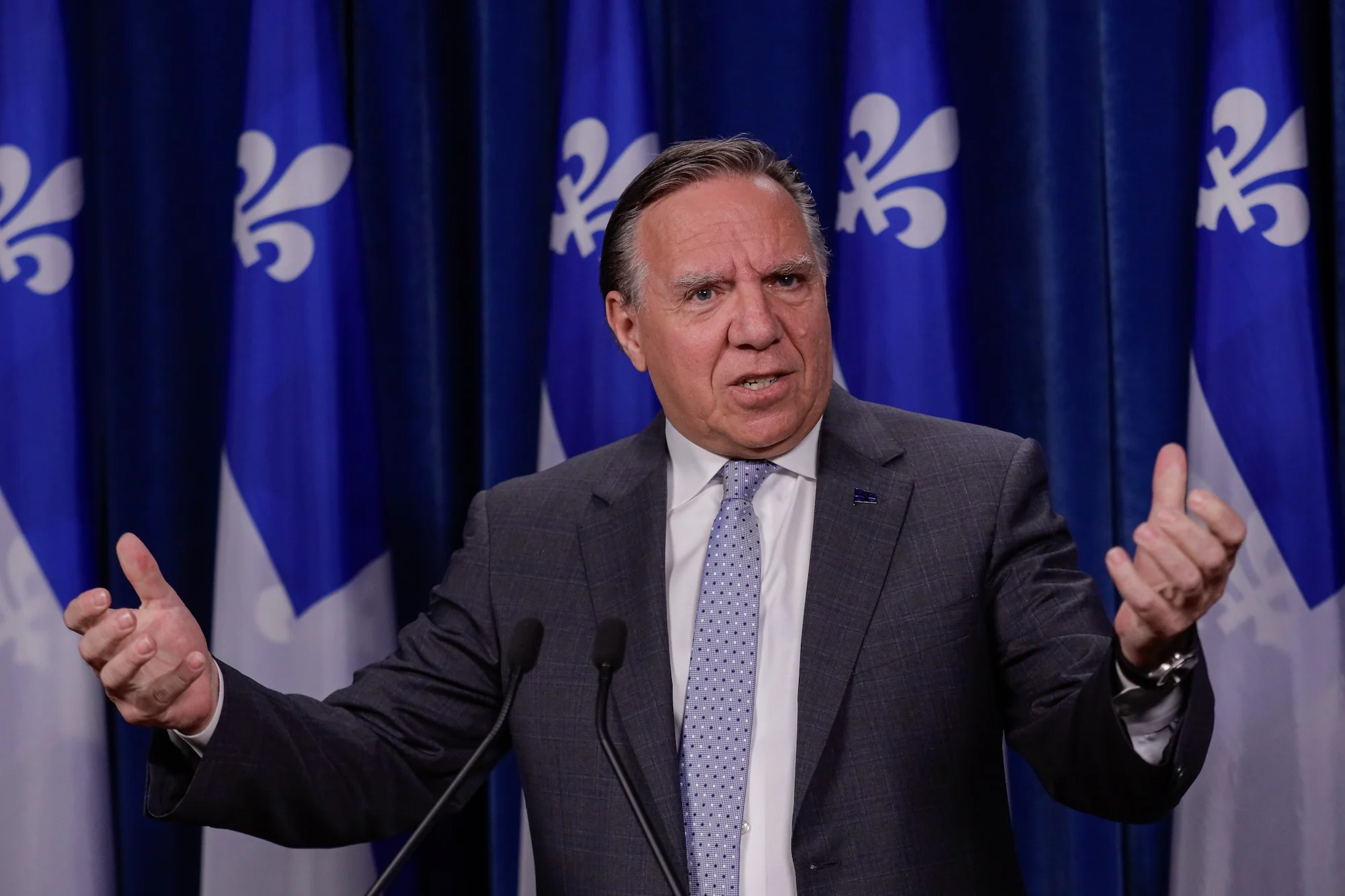
Quebec’s government has unveiled a new proposal that would tighten its already controversial secularism law, adding fresh limits on public prayer and restricting religious accommodation in public institutions.

The measures, presented on Thursday by the Coalition Avenir Québec (CAQ), build on the province’s 2019 law that bans certain public-sector workers from wearing religious symbols while on duty. That law remains one of the most divisive issues in Canadian politics and is currently headed to the Supreme Court.
New Restrictions Under “Secularism 2.0”
The new legislation, known as Bill 9, would expand the reach of the earlier law.
Under the proposal, Quebec would:
- Extend the ban on religious symbols to employees in subsidized daycares.
- Require authorization from municipalities for “collective religious practices” such as public prayer in parks, streets, or squares.
- Prohibit face coverings for students and staff from daycare through post-secondary institutions.
Jean-François Roberge, the minister overseeing secularism, said the bill aims to balance “individual and collective rights,” calling it a natural evolution of Quebec’s secular identity.
Government Cites Public Prayer Protests
Roberge pointed to recent demonstrations, including pro-Palestinian gatherings where public prayer took place, as a reason for adding new restrictions.
He argued that transforming public spaces into sites of worship without permission disrupts traffic and community life. “It is shocking to see people occupy public space without permits and turn our streets and parks into places of worship,” he said.
Critics Warn of Division
Opposition parties and civil society groups swiftly criticized the proposal.
The Parti Québécois accused the CAQ of intentionally fuelling cultural tensions ahead of next year’s provincial election.
The National Council of Canadian Muslims said the government was “doubling down on identity politics,” arguing that the proposal will further marginalize religious minorities.
Secularism Debate Deepens in Quebec
The province has grappled with the secularism debate for years, particularly since Bill 21 became law in 2019. That law bans judges, teachers, police officers, and several other public officials from wearing religious symbols. It also requires people to both give and receive public services with their faces uncovered.
The Quebec government shielded Bill 21 from charter challenges by invoking the “notwithstanding clause,” which allows provinces to override key constitutional rights. Critics say the law disproportionately affects Muslim women who wear the hijab.
The Supreme Court is expected to hear arguments on Bill 21 early next year, a case that may influence how far governments can go in restricting religious expression.
Recent Incidents Prompt Tougher Measures
Several incidents have kept the secularism debate at the forefront.
Last year, 11 teachers—mostly of North African origin—were suspended from a Montreal elementary school after a government review accused them of promoting “Islamist” beliefs and avoiding topics like science and sex education.
The Legault government responded by promising to strengthen secular guidelines in schools. In August, a government-appointed committee recommended banning religious symbols for daycare workers and phasing out public funding for private religious schools.
Just last month, Quebec expanded secularism rules to include any school staff member who interacts with students and barred students from wearing face coverings.
A Long History of Laïcité
Secularism, or laïcité, has been a central value in Quebec since the 1960s, when the Catholic Church’s influence declined sharply.
A recent Leger poll found that 68% of Quebecers view secularism as an important societal value.
Quebec’s laws mirror measures introduced in parts of Europe. France, for example, has long banned conspicuous religious symbols in schools and prohibits full face coverings in public.
As debate intensifies, Bill 9 is expected to renew national discussions about how Canada balances secular governance with religious freedoms.