












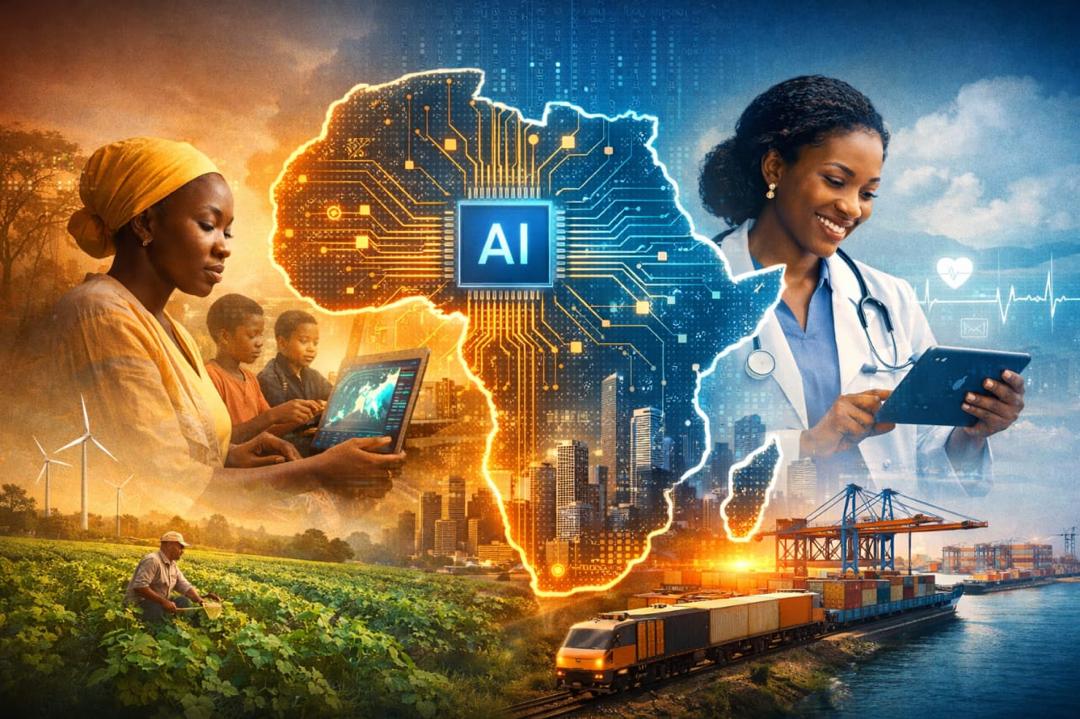
Africa’s AI surge is no longer a distant idea or a trend borrowed from elsewhere. It is already shaping how countries across the continent govern, innovate, educate, and deliver public services. From students in rural classrooms using digital learning tools to AI systems helping detect financial crime in major cities, artificial intelligence is increasingly working behind the scenes of everyday life.

Across Africa, governments, startups, and technology leaders are investing in digital infrastructure and local innovation. Their goal is not only to adopt AI, but also to shape it around local needs, languages, and values. As a result, Africa’s AI surge is becoming a major force in the continent’s digital future.
AI in governance and the economy
One of the clearest signs of Africa’s AI surge is the growing focus on national AI strategies. Zimbabwe, for example, has unveiled its National Artificial Intelligence Strategy for 2026–2030, positioning itself around the idea of “AI for Development.” Grounded in Ubuntu ethics, the framework emphasizes economic sovereignty and the use of AI in sectors such as agriculture, health, and mining.
To support the rollout, Zimbabwe has also initiated discussions with major international partners on AI expertise, governance, and implementation. This reflects a wider effort across the continent to build AI systems that are not only effective, but also aligned with local priorities.
Regional institutions are also responding to Africa’s AI surge. The Economic Community of West African States, or ECOWAS, is laying the foundation for a more unified digital vision through a proposed Regional AI Governance Framework. The aim is to balance innovation with safeguards while supporting a Regional Digital Single Market that can strengthen cross-border trade and payments.
At the same time, Egypt is expanding AI-powered digital platforms designed to reduce bureaucracy, attract foreign investment, and streamline trade processes. These efforts show how AI is becoming part of economic modernization across Africa.
The startup ecosystem is also playing an important role. In Ethiopia, Gebeya launched Dala, an AI builder that allows entrepreneurs to create applications using local languages. The company was recently selected as one of eight startups for the Afreximbank Accelerator Programme. ALX Ethiopia has also added momentum by hosting the Addis AI Leadership Forum and deploying Chidi, an AI learning companion.
Together, these initiatives show that Africa’s AI surge is not limited to government planning. It is also helping entrepreneurs, developers, and learners build practical tools for business and innovation.
AI in health and innovation
In Guinea, AI is transforming one of the most critical areas of healthcare. The Ayooka platform serves as a national digital blood transfusion management system. Its AI-assisted stock management helps anticipate blood shortages, plan collection campaigns, and reduce expired supplies.
This kind of system shows that Africa’s AI surge is not only about abstract innovation. In some cases, it is directly improving public health systems and helping save lives.
AI is also being used to solve routine consumer problems. In Egypt, KNOT Technologies recently launched an AI-powered ticketing platform aimed at reducing fraud in event sales. By using AI for buyer identity authentication and real-time demand monitoring, the platform helps limit unauthorized resale, fake tickets, and event-related scams.
These applications demonstrate that Africa’s AI surge is shaping both essential public systems and everyday digital services. They also show how innovation is becoming more practical, targeted, and responsive to real challenges.
None of this, however, is possible without strong infrastructure. In the Democratic Republic of the Congo, the government has unveiled an ambitious $8.7 billion national digital transformation plan for 2026–2030. The plan focuses on broadband expansion, e-government platforms, and data sovereignty.
Through this initiative, the DRC aims to connect 30 million people and create 700,000 jobs. This underlines a central reality of Africa’s AI surge: long-term AI growth depends on investment in connectivity, public systems, and digital institutions.
AI in education and skills development
Education is another area where Africa’s AI surge is becoming more visible. In Ghana, AI-based learning tools are being integrated into national school curricula. Supported by major investment, these systems are designed to work without data charges and to recognize local languages and accents such as Twi, Ewe, Dagbani, and Hausa.
This approach can help make digital education more accessible, especially for rural and underserved communities. It also suggests that AI can help narrow long-standing inequalities in access to quality education.
Africa’s AI surge is also being shaped by the next generation. In Somalia, tech hubs focused on digital innovation are beginning to play a larger role in the country’s technology landscape. T-Hub for Entrepreneurial Leadership, for example, is working to empower young entrepreneurs to learn about and apply artificial intelligence.
As these hubs grow, they may help build the wider ecosystem needed to address local challenges through technology and entrepreneurship. Their emergence shows that AI in Africa is not only being driven by institutions, but also by youth-led ambition and local creativity.
The quiet influence of Africa’s AI surge
Many of these initiatives are still in their early stages. Even so, they reflect a broader shift in how African countries are approaching technology. AI is quietly influencing public administration, economic sovereignty, healthcare delivery, education, and digital entrepreneurship.
Rather than simply importing foreign software, many African governments and innovators are trying to build local frameworks that respond to their own realities. In that sense, Africa’s AI surge is not only about adoption. It is also about agency, strategy, and participation in shaping the digital future.
Looking ahead
Over the next decade, Africa’s AI surge is likely to expand further, from smarter cross-border trade systems to more responsive public services. At the same time, this growth raises serious questions about privacy, infrastructure gaps, digital colonialism, and governance.
How African leaders respond to these questions will matter just as much as the technology itself. By understanding, regulating, and investing in AI wisely, they can help ensure that this transformation serves the continent’s most urgent needs.