














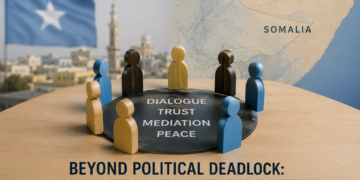

























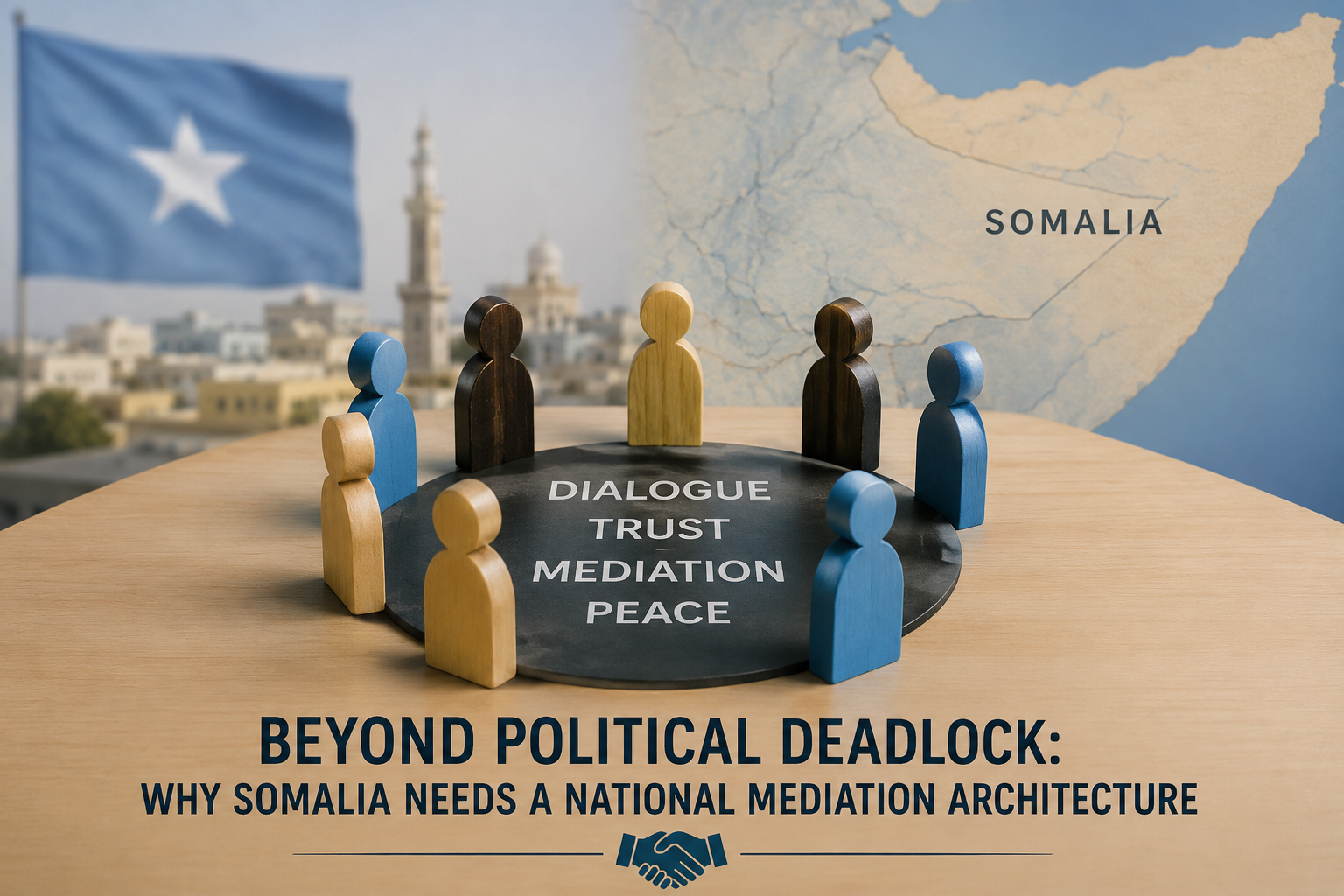
Somalia’s recurring political conflicts reflect deeper structural weaknesses beyond disagreements among political leaders. Analysts say the country needs a national mediation architecture to manage disputes before they escalate into national crises.
Political tensions in Somalia often follow a familiar pattern. Disputes emerge over elections, constitutional interpretation, or federal relations. Temporary agreements then calm the crisis, but underlying issues remain unresolved.
Experts argue that Somalia continues to rely on ad hoc mediation efforts instead of institutionalized conflict management. Elders, religious figures, political leaders, and international partners often intervene during crises. Although those efforts sometimes prevent escalation, they usually come after mistrust has already grown.


As a result, political disputes repeatedly return.
Why mediation matters
The debate raises a broader question about governance in Somalia: why is mediation still treated as an emergency response instead of a permanent institution?
Countries that experienced conflict have increasingly adopted long-term mediation systems to maintain stability. In many cases, peace agreements alone did not secure lasting peace. Instead, institutions that manage disagreements peacefully became essential.
Kenya’s experience after the 2007-2008 post-election violence is often cited as an example. The country later developed national and local peace structures that helped reduce tensions during later elections.
Similarly, South Africa’s National Peace Accord structures supported dialogue during its democratic transition. Ghana also established a National Peace Council that brings together political parties, traditional leaders, and civil society groups to address tensions early.
Rwanda invested in reconciliation and community dialogue systems after conflict to strengthen social cohesion.
Somalia’s complex political environment
Analysts say these lessons are relevant for Somalia because of its highly complex political landscape.
The country includes federal institutions, Federal Member States, opposition groups, clan leaders, religious authorities, civil society organizations, and international stakeholders. While all hold legitimate interests, they often lack a consistent platform for structured engagement.
Without trusted mechanisms for dialogue, disagreements can quickly trigger paralysis or instability.
Political negotiations in Somalia also tend to focus on immediate disputes instead of broader governance challenges. Consequently, agreements often become short-term compromises rather than lasting solutions.
One principle frequently used in international peace processes states that “nothing is agreed until everything is agreed.” The approach recognizes that elections, constitutional arrangements, security systems, and resource sharing are interconnected.
Analysts say a national mediation architecture could help Somalia address these issues within one coordinated framework.
Building institutions for dialogue
Supporters of the proposal stress that mediation structures would not replace formal state institutions. Instead, they would complement them through dialogue platforms, conflict prevention systems, and early warning mechanisms.
They also argue that mediation reflects political maturity rather than weakness.
“Good politics is not the absence of conflict; it is the way the conflict is contained and addressed without breaking the system,” the article states.
Somalia already has strong foundations for dialogue through traditional conflict resolution systems, elders’ mediation, and religious engagement. Analysts say the challenge is linking those traditional mechanisms with formal national institutions.
Experts also emphasize the need for professional mediation capacity, institutional continuity, and sustained political will.
A strategic decision for Somalia
Observers say Somalia now faces a strategic choice. The country can continue reacting to crises after they emerge, or it can invest in systems designed to prevent escalation.
Supporters of reform believe a sustainable national mediation architecture could reduce instability and strengthen political resilience over time.
They argue that Somalia’s future stability will depend not only on political agreements, but also on the institutions created to manage inevitable disputes peacefully.